- Scholastic Alchemy
- Posts
- Links and Commentary 1/16/26
Links and Commentary 1/16/26
Is MAP bad?, Equitable Funding, Schools Have Changed, AI Learning and Agency, Calls for better elementary math

James Shanahan
January 16, 2026
Hi! This is Scholastic Alchemy, a twice-weekly blog where I write about education and related topics. Wednesday posts are typically a deep dive into an education topic of my choosing and Fridays usually see me posting a selection of education links and some commentary about each. If Scholastic Alchemy had a thesis, I suppose it would go a little like this: We keep trying to induce educational gold from lead and it keeps not working but we keep on trying. My goal here is to talk about curriculum, instruction, policy, public opinion, and other topics in order to explain why I think we keep failing to produce this magical educational gold. If you find that at all interesting, please consider a paid subscription here, or at the parallel publishing spot on Beehiiv. (Some folks hate the ‘stack, I get it.) That said, all posts are going to remain free for the foreseeable future. Thanks for reading!
Is MAP a bad assessment?
You may recall that I wrote a bit about the MAP assessment suite in a links and commentary post back in October. At the time, the publishers of the MAP assessment had released some data about improvements in math scores among students taking MAP assessments. What I ware more interested in talking about, though, was the role that extrascholastic organizations — companies, nonprofits, think tanks, venture capitalists — have in education. Our media and social media are rife with commentary about teachers, school policies, curriculum, etc. but we rarely talk about the impact that other outside organizations have. We also don’t pay attention to how these organizations are increasingly consolidated into just a few firms. What had been called the Northwest Evaluation Association was an early pioneer in computerized assessment, creating the MAP. Over the years, they were purchased by educational publisher Houghton Mifflin Harcourt. Houghton Mifflin Harcourt, in turn, was purchased by a private equity firm, Veritas Capital. Veritas Capital also owns the thing that used to be the assessment division of the American Institutes of Research. What this means is that the largest non-governmental suite of K-12 assessments and the largest publisher of education curriculum and materials are all owned by the same investment firm.
Anyway, last week educator Ben Zulaf wrote an interesting post saying that It’s Time to Ditch MAP. I’ve seen it pop up a few times since and apparently educators are very dissatisfied with the usefulness of student data they receive from MAP assessments. Ben writes,
Considering that the challenge lies with the text, not the questions or standards to which they align, this is very problematic. The lack of information that teachers have about the texts students read in combination with the fact that students’ ability to comprehend doesn’t transfer across all texts and the infrequent shifting of groups render the instructional groupings [recommended by MAP] next to useless.
He also makes in incisive point about things that MAP talks about as “skills” actually being about background knowledge and comprehension.
The problem is that these are not skills, as I discussed here. Skills are your ability to complete a task competently, and they are transferable. For example, once you learn to ride a bike, you’re able to ride pretty much any bike that has two wheels because riding a bike is a transferable skill. The same thing is not true in reading. Using this report, MAP informs this classroom teacher that this student is ready to develop the skill of determining the cause and effect of a situation or event in informational text. Going back to the baseball study, the poor readers who had a lot of baseball knowledge were able to describe the causes and effects of what they read better than the proficient readers with little baseball knowledge. With that passage, that “skill” was already developed even though a standardized test may have indicated differently. This is true for all topics. I taught in a community that valued soccer, so my students’ ability to explain the causes and effects in a soccer game was highly developed. Their ability to explain the causes and effects of mitosis, a topic that I was to introduce in science, was not.
He closes,
If MAP can’t do these things, then what can it do? It can tell you if students can or cannot read grade-level texts proficiently, and it does a good job with this one task. It also provides you with some nice growth charts, detailing who made expected growth vs. who did not and who had high growth and high achievement to low growth and low achievement. But when you consider that NWEA provides you with a lot of misinformation, information that can lead to many poor instructional decisions, the cost of this tool just doesn’t seem worth it.
Karen Viates called this post important, so I expect to see more discussion of MAP in more mainstream publications soon. Dylan Kane, meanwhile, says he thinks MAP actually drives scores down on state exams. In general, I think more people who are serous about high quality curriculum, instruction, and assessment are finally coming around to the view that our system of standards, whether common core or their replacements, is premised on a flawed conception of learning-as-skill-acquisition.
Worth keeping an eye on!
Equitable Funding
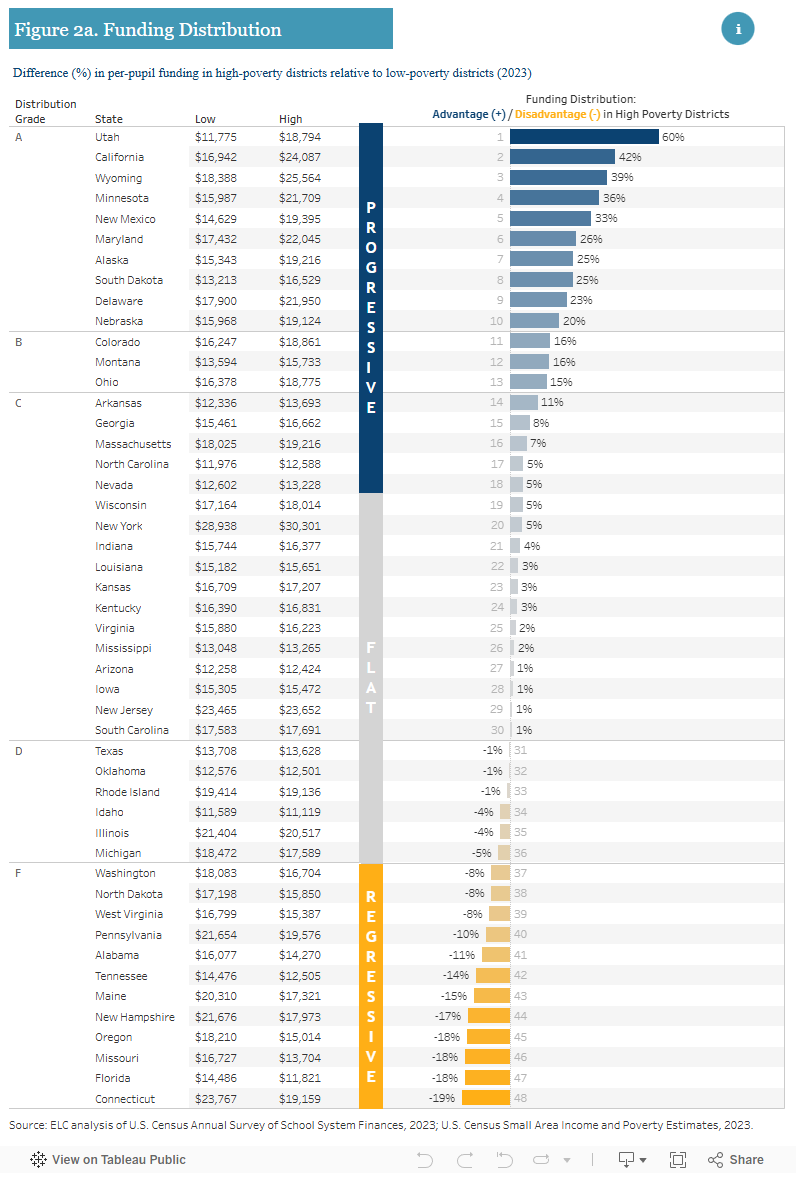
Via Peter Green, I saw an interesting report about which states provide the most equitable school funding. Most of the time when we talk about school funding, we focus on a flat per-pupil headline number. New York spends the most per pupil at $29,440 (“cost adjusted”) and states like Idaho and North Carolina spend the least at $11-12,000 (again, “cost adjusted”). These are numbers policymakers and commentators are very used to and they tell one kind of story, usually one about “value for your money” or “ROI”. And, usually, what happens is you find out that traditionally blue states spend a lot per pupil and red states spend little per pupil. But, what gets really interesting in this report is the analysis of which districts get additional funding. The idea being, poor school districts face greater challenges, so they require additional resources. When looked at this way, the list of top and bottom states shifts and defies convenient (lazy) political narratives.
source
The top states are red and blue, heavily populated and sparsely populated, and geographically diverse, representing most regions of the country. It’s a much more interesting way to look at how states make decisions about where to send resources and may give some much needed nuance to discussions about school funding. Now, the report goes on to detail something called “Funding Effort” which essentially places the above numbers in relation to the wealth of each state but I think that’s less useful because it’s really a measure of tax policy and economic activity. New York looks good on that measure because it has a huge economy, high taxes, and spends a lot per pupil but if, as the above chart indicates, the spending isn’t doing as much as it could to help poorer schools, then the “effort” seems misplaced. It doesn’t tell us anything new that flat out per pupil expenditures already tell us. Anyway, it’s overall worth a look.
Schools Have Changed
Audrey Waters reminds us that schools have, in fact, changed since the early 1900s. This is, for Audrey, a reminder she makes often because one of the biggest arguments reformers and salespeople make is that schools never change, hence the need for reforms and products.
2026 marks the 100th anniversary of Sidney Pressey's landmark article that launched the whole teaching machine industry: "A simple apparatus which gives tests and scores-- and teaches." Pressey, like many early educational psychologists, had worked on early efforts to develop standardized testing -- at first a way to rank and rate soldiers in World War I and then a way to rank and rate students. Pressey and others believed that an educational machinery could automate both testing and, importantly, teaching. And while his device predated the computer by decades, the digital tools that followed have never really broken from this legacy
Waters goes on to argue that schools have been changed by teaching machines but, in some ways, it is those changes from the teaching machines that people then refer back to in order to say schools never change. Take this excerpt for example,
these ideas, these technologies have changed education. They have reshaped how we think about thinking (the pervasiveness of the mind-as-machine metaphor); they have altered pedagogical practices; they have shifted the kinds of work that students and teachers do, along with the ways in which they do them. They have shaped the expectations of what students and teachers believe they can do -- not just the “everyone should learn to code” stuff and the twisting of the purpose of education to be solely about job training and “career and future readiness,” but about how students understand their own abilities, how they see (or don’t see) their own agency, how they control (or don’t control) their own inquiry, curiosity, attention.
So, if we’re at the 100th anniversary of Pressey’s influence, then aren’t we saying schools haven’t changed, actually? Like, if you tell Mr. Silicon Valley EdTech that schools are still beholden to behaviorist psychology, they’ll use that as ammunition to say schools haven’t changed and that they need [insert product]. Now, this may read as an objection to Waters but that’s not my point. Instead, I think change is the wrong framework for thinking about schools over time. Instead, we should see tensions, pushing and pulling schools and schooling in various directions and in many directions at once. So, behaviorism and psychological theories related to Pressey and Skinner and the downstream implications are but one ongoing position that seeks to influence schools. We should simply and flatly explain that, yes, of course schools have changed over the last century. They’ve changes over the last decade. They will keep changing.
Sometimes it’s helpful to communicate with business/tech/sales types using language they’ll be more familiar with. You may remember the phrase “disruptive innovation” or its shorter version, disruption, as the mantra of the tech industry in the 2000s through late 2010s. That phrase comes from the work of business economist Clayton Christensen who was, more or less, reframing the macroeconomic concept of creative destruction for the microeconomic space of competition between firms and tech startups. What people don’t know is that Christensen later put a lot of time into thinking about schools and schooling. Interestingly, he didn’t take the typical business-oriented view of school change or school reform. In fact, he wrote about schools in a way that was quite sympathetic to the situations schools find themselves in and offered a defense of schools that included just how much they do, in fact, change and for the better.
Schools actually have been improving — moving up the vertical axis of their industry just like the companies in all industries we have studied. In a manner analogous to disruption in the private sector, society has moved the goal posts on schools and imposed on them new measures of performance. What is unique about public schools is that laws and regulations make them a virtual monopoly, which makes it difficult and sometimes impossible for a new business model to compete on the new measures. Society has asked schools to pursue the new metric of improvement from within the existing organization, which was designed to improve along the old performance metric. In essence, the public schools have been required to do the equivalent of rebuilding and airplane in mid-flight — something almost no private enterprise has been able to do. On average, however, schools have done just that — adjust and then improve on each new measure. But doing so has not been easy.
- Christensen & Horn, Disrupting Class, p.51.
emphasis italics are original
Frankly, this is how people who care about schools should talk to people who say that schools don’t change or haven’t changed in a century. Not only have they changed, but schools have changed in ways that businesses would fail to do. Because schools are not businesses in a capitalist market, you (the reformer I’m hypothetically talking to) may not be prepared to recognize that change, but the truth is they can and do change in response to public needs.
I also can’t resist quoting his dig at edtech products later in that chapter which reads just as true today as when he wrote it 18 years ago. Here, Christensen shares some common ground with Waters. He recognizes in these products the same kind of thinking about learning that Pressey had.
…while people have spent billions of dollars putting computers into US schools, it has resulted in little change in how students learn. And most products that the fragmented and marginally profitable educational software industry has produced attempt to teach students in the same ways that subjects have been taught in the classroom. As a result, they have catered to the intelligence type that has been historically privileged in each subject.
p.65
When Christensen says “the same way subjects have been taught” and that they “cater to the intelligence type,” he’s talking about classrooms designed to privilege the kind of intelligence from an IQ test and the kind of instruction that doesn’t try to fit kids’ cognitive or psychological needs. In other words, the Pressey shit. What I find most fascinating about this is that Waters and Christensen probably could not be farther apart ideologically but both arrive at similar conclusions. Schools do change. The products people sell to schools are poor quality and rely on an understanding of learning that is a century out of date. That’s the big point here! It’s not that schools didn’t change, it’s that your product is re-capitulating the way people thought about learning before WW1. What’s unchanged is actually the EdTech, the AI products, the personalized learning because behind all the sales pitches and fancy interfaces and data dashboards is an archaic view of the psychology or learning. Christensen saw it and Waters does too.
AI, Learning, and Agency
Speaking of edtech, David Demming penned a lovely post about how using generative AI to learn is like Odysseus untying himself from the mast. As an English major and someone who is super excited for the upcoming Christopher Nolan adaptation of The Odyssey, I am here for this metaphor.
With generative AI, both the inputs and the outputs are fully personalized. Every time you ask ChatGPT a question, you get a unique response that reflects your conversation history and what the chatbot knows about you. The personalization is what makes AI feel like magic. And yet personalization also creates temptation. Generative AI tools are so flexible, you can ask them anything, and they’ll never tell you to stop messing around and get back to work.
A vivid illustration of our divided self comes from a famous behavioral economics paper called “Tying Odysseus to the Mast: Evidence from a Commitment Savings Product in the Philippines”. They found that customers flocked to and greatly benefited from a bank product that prevented them from accessing their own savings in the future. Just like when Odysseus tied himself to the mast of his ship so that he would not be tempted by the alluring song of the Sirens.
The Sirens are often portrayed as sexual temptresses in art and popular culture. But Homer never describes the Sirens bodies or gives any sense that their physical allure. Here is a translated excerpt from the 12th book of the Odyssey (emphasis mine) – “For never yet has any man rowed past this isle in his black ship until he has heard the sweet voice from our lips. Nay, he has joy of it, and goes his way a wiser man. For we know all the toils that in wide Troy the Argives and Trojans endured through the will of the gods, and we know all things that come to pass upon the fruitful earth.”
The Sirens offer Odysseus the promise of unlimited knowledge and wisdom without effort. He survives not by resisting his curiosity, but by restricting its scope and constraining his own ability to operate. The Sirens possess all the knowledge that Odysseus seeks, but he realizes he must earn it. There are no shortcuts. This is the perfect metaphor for learning in the age of superintelligence.
Demming’s overall point is that if we’re not limiting students’ agency vis a vis learning with AI, then they are going to let it do too much for them. The learning part will go by the wayside. Kids (and let’s be honest, everyone) will take the knowledge-without-effort path.
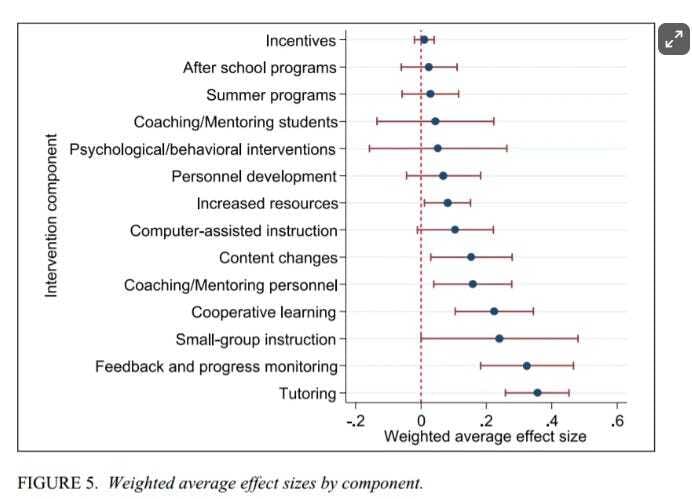
My only quibble is that Demming argues personalized learning and computer aided instruction are super effective. I disagree. In fact, I think it’s pretty clear that personalized learning is a bit of a chimera and we should be skeptical of claims about it. As far as computer aided instruction goes, I’m sure the one research group’s product, Mindspark, Demming pulls from is quite inspirational, but when you weigh the extant literature on CAI it’s not great. Not awful, but not great. Middle of the pack, in fact. Actual tutoring was far better than CAI. So are cooperative learning, small group instruction, and metacognitive approaches like feedback and progress monitoring.
Call for better Elementary Math
Linda Diamond argues that elementary mathematics needs less constructivism and more “cognitive and behavioral science” which I think is the same thing as the new and trendy “science of learning” but is more than anything just information processing theory with better marketing.
Anyway, I think the post is concise and makes the case that when learning the foundational stuff, kids need to be able to focus their cognitive resources on the actual math to be learned and less on the inquiry. While I worry that the science of learning folks may find their approaches are misunderstood or taken too far (SoL rockstar Carl Hendrick is also worried about this, by the way), I still think schools and learners are better off in a world where teachers and schools are thinking about SoL concepts. Toward that end, here are a pair of charts from Diamond’s post that might be useful.
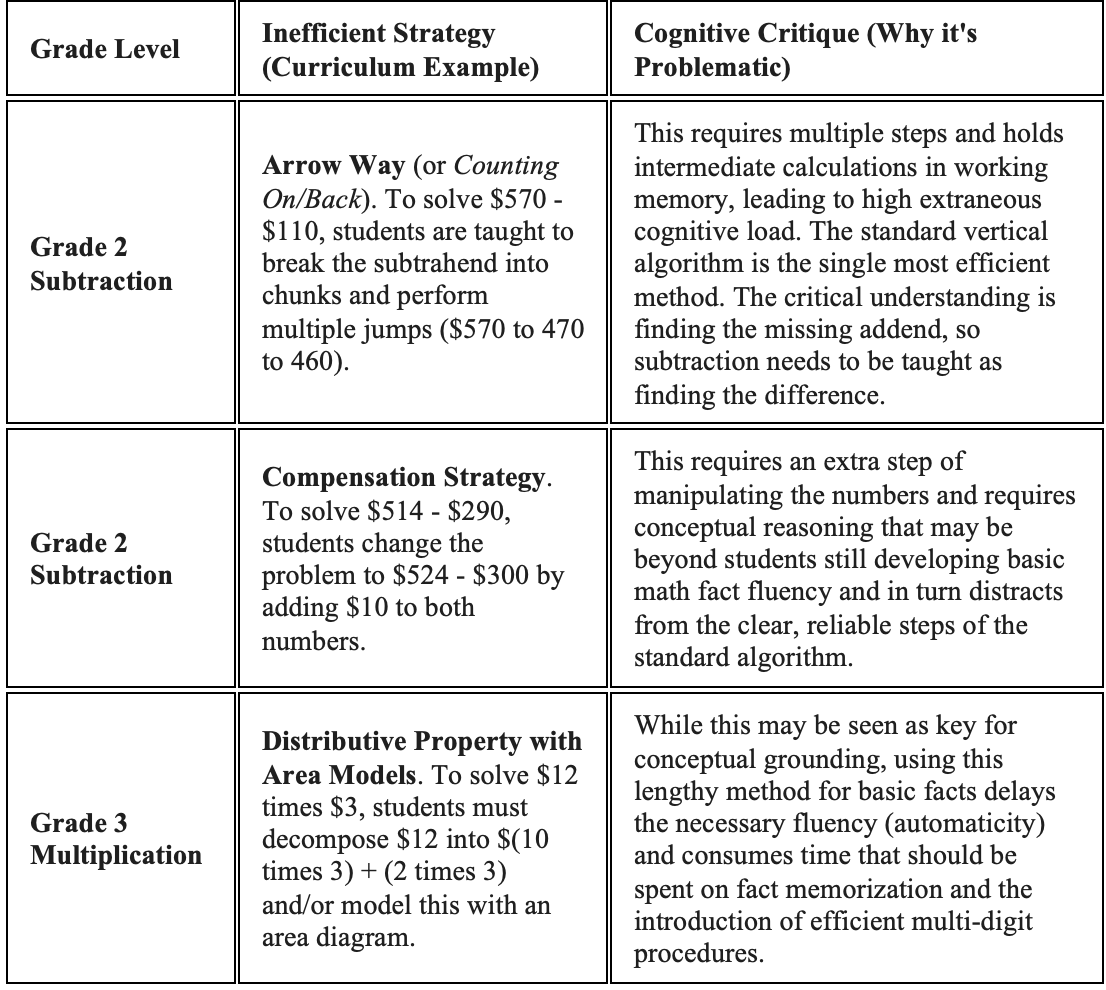
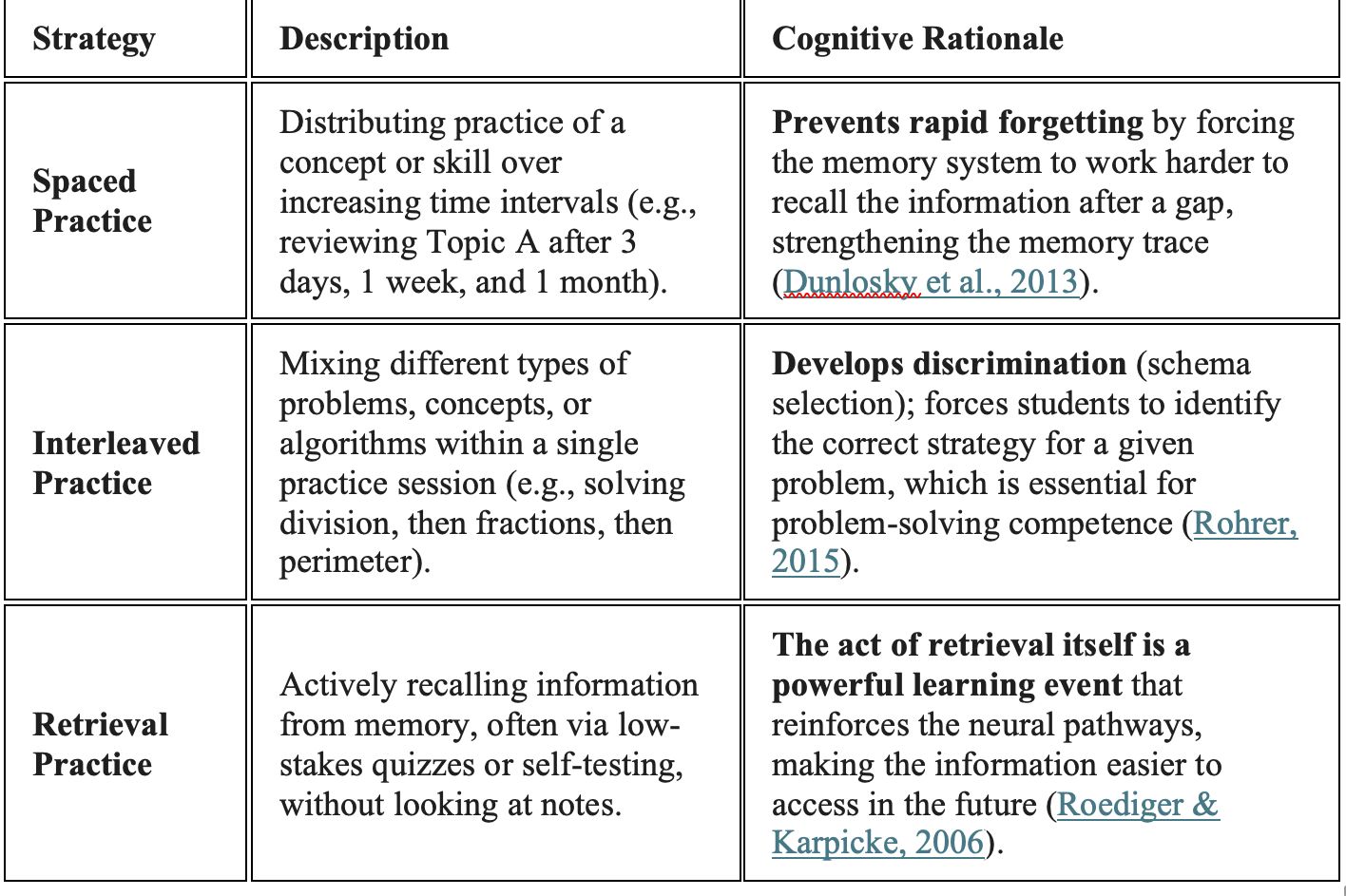
Obviously these are taken from her consulting work but I think there’s some decent empirical support for these approaches so it’s not just a sales job on Diamond’s part.
That’s all for today, thanks for reading!