- Scholastic Alchemy
- Posts
- Links and Commentary 12/19/25
Links and Commentary 12/19/25
Kids in Boxes, Who Really Lacks Accountability?, Zeroing Public Ed, State Test Score Summary, Knowledge Building Woes

James Shanahan
December 19, 2025
Hi! This is Scholastic Alchemy, a twice-weekly blog where I write about education and related topics. Wednesday posts are typically a deep dive into an education topic of my choosing and Fridays usually see me posting a selection of education links and some commentary about each. If Scholastic Alchemy had a thesis, I suppose it would go a little like this: We keep trying to induce educational gold from lead and it keeps not working but we keep on trying. My goal here is to talk about curriculum, instruction, policy, public opinion, and other topics in order to explain why I think we keep failing to produce this magical educational gold. If you find that at all interesting, please consider a paid subscription here, or at the parallel publishing spot on Beehiiv. (Some folks hate the ‘stack, I get it.) That said, all posts are going to remain free for the foreseeable future. Thanks for reading!
Programming Note: There will be no posts next week as I’ll be doing holiday family stuff. Touch grass snow, read some fiction, be with family, play a video game, or whatever. The world can wait. Mine will.
Kids in boxes
As a second graded in Catholic elementary school, I was poorly behaved. Sister Barone used a color-based disciplinary system and if you misbehaved a cartoon clown holding balloons with your name on it would lose balloons. Green, yellow, orange, red, and then black. If you got to the black balloon, she’d lock you in the coat closet for some amount of time. I spent a lot of time locked in the coat closet, mostly because I was speaking out of turn or couldn’t sit still. I’m not sure what I learned from this experience because I never really reformed my behavior. Instead, I moved up to 3rd grade and that teacher had a wholly different classroom management style and I almost never got in trouble. Or, maybe, I just need to grow and develop a bit more in order to have the capacity — the executive functioning — to enact the needed self-control. Who knows? What I do know, now after many years of teaching and studying learning and research and all that, is that these kinds of punitive isolation techniques don’t work and aren’t pedagogically effective. It’s far better to teach kids to manage their behaviors than it is to punish them into good behavior. I also know I became a much happier kid after my parents moved me to public school.
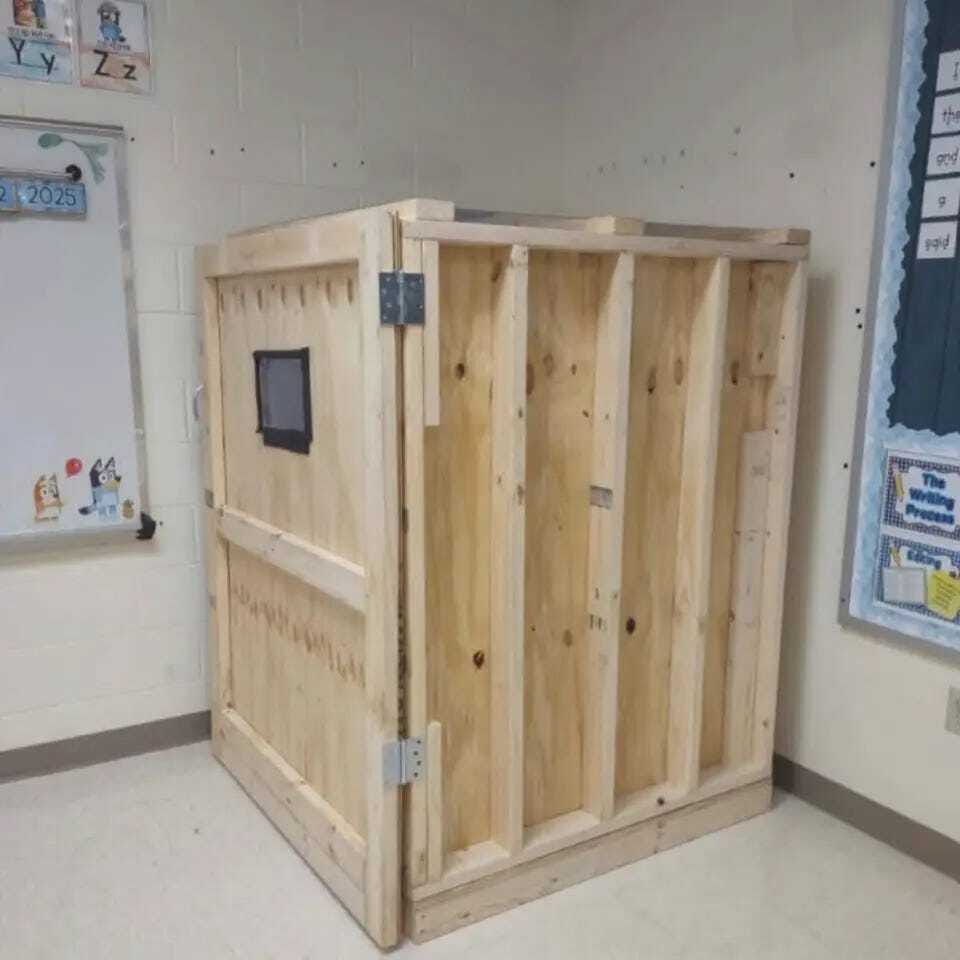
source
Now, there is some dispute between parents who say their kids have been put in these boxes, school officials who claim the boxes are brand new and have never been used, and the state who says these are illegal and should be removed immediately. I am inclined to believe the parents and, look, if they were built and placed in classrooms, then there was a purpose behind them and intent to use them. It appears to be that they were for secluding kids with disabilities who were in moments of crisis and were potentially harming themselves or others. I don’t work in healthcare or psychology or provide clinical services of any kind, but my understanding is that it’s exceedingly rare to need to use restraint or seclusion and when it is used, it’s never in a windowless locked box with total isolation.
There’s also this added wrinkle:
The allegations are unfolding in a Franklin County school district where 60% of students are Native American. One of the schools where the boxes were allegedly used is located on the St. Regis Mohawk Tribal Reservation. Members of that community said at the meeting the timeout boxes are a painful reminder of the trauma suffered by their relatives at Native American residential and day schools, some of which allegedly inflicted horrific abuse on their students.
I wish I could say I’m surprised, but I am not. I often have to remind people that schools are not some wildly free-love flower-child progressive anything goes institution. They are often very authoritarian in their approach to managing and controlling children and the kids most likely on the receiving end of schools’ coercive and punitive authority are the poor, the minorities, and the disabled.
Who Really Lacks Accountability?
In the above link, we learn that the state is investigating the school where these boxes were deployed and has placed the school’s leadership on leave, all the way up to the district superintendent. We also learn that parents were showing up to school board meetings and raising their concerns. The board is subject to the will of the citizens because it is elected by the citizens. We call this democracy and it’s the foundation of our political system and national self-image from the federal level all the way down to every locality in the country. When people like me talk about democratic control of schools, we’re often not talking about the power of the people to limit the authoritarian tendences of our institutions but that is part of the democratic package. It also means that our localities and states are ostensibly responsible for and accountable for ensuring children are adequately educated. This is why if a kid shows up at school and then wanders off, people get very mad at the school. It’s their job to care for those kids, educate them, and keep them safe and supervised during the school day. If they don’t we expect the school board or even the state to intervene.
I’ve written before about how this democratic model of schooling and who is accountable for schooling is changing. While our country’s left and left-center education punditry and journalists continue to fight the last war, conservatives have moved on from the vision of a democratic education where governments make sure all kids have access to quality schools. Instead, they’ve gone from championing school choice to pressing for parent choice. The shift in logic here is explained in a Harper’s article about school choice in Arizona.
One thing all ESA advocates love to talk about is “customization”: the ability to tailor an educational experience to your child’s needs. With an ESA, families can stack their chosen home-education or microschool curriculum with dozens of extracurricular opportunities provided by vendors on the marketplace. That can mean paying a fee to your local public school so that your son can play on the football team, or hiring a private tutor to teach your daughter Lithuanian twice a week. Many microschools inevitably become base camps for such customization, either by providing the space for a vendor to run a class or by blending various options into their own programming.
With ESAs, the school-choice movement has finally made a decisive pivot to the original parental-choice model Friedman had in mind. In the process, it has rewritten the underlying motivations for education reform. “Public education, correctly understood, is not about school systems but rather the empowerment of parents and the flourishing of children,” the Notre Dame law professors Nicole Stelle Garnett and Richard W. Garnett wrote in a 2023 City Journal article about ESA programs. That is, the motivations are primarily moral rather than academic: “Parental choice should be embraced not because it will improve test scores but because empowering parents is the right thing to do.”
So, to be clear, advocates of ESAs and other similar voucher schemes say it’s not the job of states to ensure kids are getting better test scores. Whether kids are better off educationally — learning, achievement, academic performance — is secondary to the moral imperative of putting parents fully and totally in charge of their children’s education. Once vouchers are involved, accountability is your problem, not the government’s problem.
It turns out that vouchers also mean that keeping track of children who use those vouchers or the money allocated to them is also not the government’s problem.
On any given day, Florida’s education department did not know where 30,000 students were going to school and could not account for the $270 million in taxpayer funds it took to support them, according to the state Senate Appropriations Committee on Pre-K-12 Education.
Kids’ academics are not a concern of the state. Kids’ attendance is not a concern of the state. How families spend state education funds is not a concern of the state. (Although it is putting a $400 million hole in Florida’s budget.) I think it’s important to recognize that this is the goal of voucher proponents. They want to completely and totally abolish public education and remove any democratic control and oversight, even though it’s state tax dollars being (mis)spent.
Zeroing Public Education
On a very related note, Peter Green looks at the personnel behind education at the Trump administration. His title, Zeroing Public Education, comes from Tiffany Justice.
The Department has also partnered with another fresh Heritage hire for Heritage Action, the political action wing-- Tiffany Justice. Justice has dropped the whole “regular mom sitting at the kitchen table baking cookies and running t-shirt sale fundraisers” baloney and embraced her role as a professional political operative. Justice had made it known that she would be delighted to serve as Trump’s education secretary. Justice helped launch the DEI tattling site (which only lasted about three months).
It was Justice who gave ProPublica the clearest, most direct quote. They asked her what percentage of children should be in public school: I hope zero. I hope to get to zero.
So much of what these folks do is best understood through that lens. Even the attempts to inject their religion into public schools can be understood as just an attempt to turn public schools into private religious schools.
My only add to Greene’s piece is that our Dear Leader’s administration also sees these reforms as a way to “increase the married birth rate”. Less schooling, more religious education, more girls kept at home, more babies.
I also have to gripe that, once again, we have a situation where people who care about public education are spending all their time fighting over standardization, accountability, curriculum, and fairness while the people who hold power are working to dismantle public schools entirely. I guess we’d rather take the easier path and tear each other down instead of mounting a proper resistance.
State Test Score Summary
I have my problems with the quality and variety of state tests but they’re still useful barometers and I am subscribed to the EDC State Assessment Data Substack so I can keep tabs. They’ve recently posted their 2025 overview. What I want to share here, though, is the map showing which states EDC says have comparable tests from 2019 to 2025.

This is pretty damned important because some very large states, such as Florida, Texas, Illinois, and New York have made changes to their state testing at some point in the last six years. Four more states have made ELA test changes. (New Jersey got a federal waiver to skip testing in 2021, so they’re noting that, but you can find EDC’s report on New Jersey’s scores here.) The big point, though, is that there are limits to what we can know about our students’ academic performance and state policies from these tests. We may want to know if we’re performing better or worse than before the pandemic but in many states the tests have changed, making today’s scores incomparable with those in 2019. While we do have the NAEP, it’s not every year, subject tests in science and social studies are even less frequent, and our ability to administer that test remains under threat. For all the bluster about test-based accountability, we need to remember that these tests are poor tools for evaluating teachers’ effectiveness.
Knowledge Building Woes
One of the louder curriculum reform movements today comes from the Knowledge Building movement. Foundationally, the knowledge building camp comes from the 1980s and ED Hirsh’s Core Knowledge curriculum. The curriculum stemmed from his complaints that diversity in schools was leading to the diminution of western culture. Schools needed to teach a core set of western European and American content so that minority groups could be better integrated into the American way of living. Core Knowledge and other related approaches under the Knowledge Building brand saw renewed attention as skills-based standardized education fell apart. One of the biggest modern proponents is journalist Natalie Wexler who reported this week on some struggles in implementing knowledge building instruction.
I thought this bit was super interesting.
Kristen McQuillan, a consultant who has worked with districts implementing knowledge-building curricula, says that from her observations, it’s clear the curricula themselves aren’t the reason so many lessons are surface-level. In many cases, she says, “teachers are changing the curriculum in pursuit of how to help kids master the standards.”
Always plenty of blame for teachers from the curriculum and instruction experts. This is, I think, part of what I warned the Science of Learning people about. See, the knowledge building people want to claim the SoL for themselves because there’s decent research related to building prior knowledge. But, prior knowledge is not the same as the kind of large-scale content knowledge that Wexler and her compatriots are talking about. Moreover, devoting time to build prior knowledge is not easy and may not even work the way we think it should. Sarah Cottinghatt reviews a pair of studies that should give us some pause.
Taken together, these two studies suggest that it isn’t nearly good enough – or accurate – to say “prior knowledge helps” (the so-called ‘knowledge is power’ hypothesis). Clearly, the range of effects found in Simonsmeier et al. (202) speak to at least two issues:
1. Prior knowledge is defined very differently in different studies. If we aren’t measuring a similar construct, it’s going to be hard to compare the results.
2. A nice clean line between prior knowledge and learning doesn’t exist. There are mediators and moderators that run interference, and these ultimately explain whether and how prior knowledge helps, hinders or doesn’t do very much at all. Like shining a light through a prism, the path alters.
She concludes,
Simonsmeier et al. (2022) and Buchin & Mulligan (2025) have thrown a cold bucket of water on lazy proclamations that ‘prior knowledge supports learning. They’ve woken us up to the stark reality that prior knowledge affects learning through multiple channels. And, like anything, (dual coding, retrieval practice, spacing, etc.) it must be thought of as part of a holistic learning process rather than examined in isolation.
Saying that, given the complexity of the relationship between prior knowledge and learning and the bloated definitions we are left with when we try to account for every facet of the construct, I think we are left with only one option: shape, constrain and direct prior knowledge as much as possible before introducing new ideas.
Assuming background knowledge from familiarity with content in the same domain won’t be good enough (Buchin and Mulligan, 2025). Neither is simply allowing students to ‘form an impression’ of what we say or hope they will construct the same organised schemas we have.
We have to engineer what we want: students using relevant, organised and activated prior knowledge to understand new ideas.
So, when Wexler encounters a study that contradicts her worldview, she seeks to blame teachers for being too beholden to standardized education and undermining knowledge building. But, if we look at people who are engaging with research with a bit of humility, we see that the situation is simply too complex for an easy Wexler-preferred solution. What appeared to her as a failure on the part of teacher may, in fact, be the impact of mediators and moderators that also need to be accounted for.
Hey, we have stories to tell about why schools are failing so we can push our preferred social engineering projects. Why let nuance and complexity get in the way?
Thanks for reading!