- Scholastic Alchemy
- Posts
- Links and Commentary 12/5/25
Links and Commentary 12/5/25
Are Schools the Problem?, Missing Mississippi Students?, Charter Finances, The Cost of the Raids, More Fertility Thoughts

James Shanahan
December 05, 2025
Hi! This is Scholastic Alchemy, a twice-weekly blog where I write about education and related topics. Wednesday posts are typically a deep dive into an education topic of my choosing and Fridays usually see me posting a selection of education links and some commentary about each. If Scholastic Alchemy had a thesis, I suppose it would go a little like this: We keep trying to induce educational gold from lead and it keeps not working but we keep on trying. My goal here is to talk about curriculum, instruction, policy, public opinion, and other topics in order to explain why I think we keep failing to produce this magical educational gold. If you find that at all interesting, please consider a paid subscription here, or at the parallel publishing spot on Beehiiv. (Some folks hate the ‘stack, I get it.) That said, all posts are going to remain free for the foreseeable future. Thanks for reading!
Are Schools the Problem?
Two weeks back the New York Times put out a piece about how schools are stressing kids out. The whole thing is worth a read, but I want to highlight one part.
There is growing evidence that school itself is essential to understanding why so many children seem to be struggling. It can be a cause of stress that exacerbates anxiety or depression; but just as importantly and less frequently acknowledged, it is often where disorder presents, leading many children — and their parents — down the path toward a diagnosis.
The experience of school has changed rapidly in recent generations. Starting in the 1980s, a metrics-obsessed regime took over American education and profoundly altered the expectations placed on children, up and down the class ladder. In fact, it has altered the experience of childhood itself.
This era of policymaking has largely ebbed, with disappointing results. Math and reading levels are at their lowest in decades. The rules put in place by both political parties were well-meaning, but in trying to make more children successful, they also circumscribed more tightly who could be served by school at all.
“What’s happening is, instead of saying, ‘We need to fix the schools,’ the message is, ‘We need to fix the kids,’” said Peter Gray, a research professor at Boston College and the author of “Free to Learn: Why Unleashing the Instinct to Play Will Make Our Children Happier, More Self-Reliant, and Better Students for Life.”
“The track has become narrower and narrower, so a greater range of people don’t fit that track anymore,” he said. “And the result is, we want to call it a disorder.”
Now, I like reading Peter Gray and have shared his work here once or twice but it’s important to understand that he’s basically a child liberationist. He is advocating rebelling against schooling more generally and that’s not something that is an option for many parents or kids. I also think abandoning all metrics around learning can lead to some pretty bad distortions in outcomes. Still, I think he is correct when he argues that standardization and high stakes testing stress kids out and I like this added point that narrow pathways to success have dramatically raised the stakes of education. We should lower the stakes.
Missing Mississippi Students?
Speaking of high stakes tests, I’m tired of writing about the Mississippi Miracle and its assorted offshoot branding opportunities, but it looks like I will have to keep doing so. At, you guessed it, The Argument, Kelsey Piper kicked off a two-part series defending the “miracle” from various criticisms. I think her argument is fine and have been persuaded that kids in Mississippi really are learning to read and are improving at a rate that exceeds what many other states are doing. I don’t think the NAEP scores are fake or whatever. But, one point I’ve always made is that there’s too much attention on some components of the reforms package and not enough on others. In penning a reply to one of the commenters to that article, I was looking up some data on the Mississippi Department of Education’s website and came across something interesting.
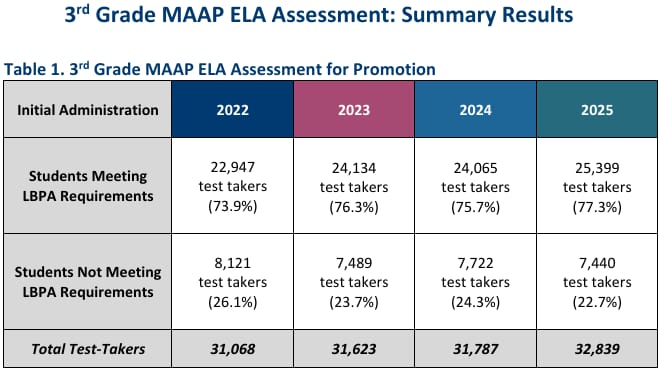
Yes, you are reading that correctly. Since 2022, between 22% and 26% of Mississippi’s 3rg graders have failed to meet the legal requirements for promotion to the 4th grade. (LBPA is the law Mississippi passed that requires 3rd graders to pass the MAAP ELA exam in order to get promoted to the 4th grade.) So, you would be forgiven for thinking that Mississippi is holding back somewhere between 1/4th and 1/5th of 3rd graders each year. They don’t pass the test, they get held back. It’s the law!
It turns out that only about 8% of Mississippi’s 3rd graders are held back. That article explains some kids can get exemptions.
Students can also still move up to the 4th grade even if they fail the test in a couple of extenuating circumstances known as “good cause exemptions.” These include a learning disability or being previously retained for two years.
As far as I can tell, this means that something like 14% of those 22% who failed are promoted anyway. Most likely these are almost all kids with learning disabilities but I don’t see any data on the MSDOE’s website that breaks down the exemptions. I’d really like to know what’s going on with this missing ~14% of kids for a few reasons. First, that’s a lot of kids being promoted despite failing and I thought the whole selling point of the Mississippi Miracle is that schools should do more retention. Second, if retention is actually a very leaky bucket, then it gives us a chance to refocus more closely on the policies that are more impactful. Teacher training, curriculum alignment, literacy interventions, and so on. Those seem to be the real miracle here.
Charter Finances
It’s a story we’ve heard hundreds of times before. A charter school closes, or in this case never even opens, and leaves parents scrambling without an option for their kids. Well, that’s not 100% true because even in Florida public schools exist and will take those kids. But here’s what I want to draw some attention to. The owners of the school are politically connected and stood to benefit financially from taxpayer dollars spent at the school that they themselves had a hand in approving. This kind of corruption is endemic in the charter sector, sadly.
The other thing is that it’s becoming too expensive to operate charter schools in Florida. Non-public options are almost entirely unregulated, as such the microschool in your neighbor’s garage, so they’re cheap to operate on the public dime. Plus, voucher-based school choice is cannibalizing the charter school sector. Charter schools are technically public schools and have to be safe for the children inside them. They need silly things like sprinkler systems and insurance.
If you’re going to open a Charter school in Florida, which some people are still trying to do, you need to get an even better sweetheart deal. Success Academy got both $50 million from a hedge fund billionaire and was able to convince the legislature to broaden Florida’s Schools of Hope program to cover many of their operating costs. Inspired by their financial windfall, other charter operators are pursuing other ways to defray their costs.
So this year, the Florida State Board of Education just went ahead and changed the rules.
Remember that problem with getting new buildings up and running. Fixed! Colocation! Now districts must provide “underused, vacant, or surplus” facilities to SOH charters. No rent, no lease, no cost, and districts can’t refuse. However, the district must provide building maintenance, custodial services, food service, and transportation. And as long as the facilities are “underused,” the district has no say.
“Underused” is a big problem here. There’s an administrative rule in the state code that defines “fully used” roughly as “no unused student seats,” but that’s not much help at all. Intermittent or irregular use? And there’s a whole world of other programs that serve students in schools. As Education Matters in Manatee points out
[P]erhaps on an Excel spreadsheet (page 2 of 4 is shown below), a classroom housing six or seven students, one teacher, and several aides may appear to be “underutilized” - but it isn’t. It is in fact providing essential services to some of the most vulnerable citizens of our county.
This is an excellent deal for charter operators and should help them in their struggle against school choice. If only Optima Classical Academy had been so cunning as to poach some “underused” space in a public school and get “free” maintenance, custodians, food services, and transportation for their kids.
Others, it seems, want their chance to cash in with 60 colocated charters approved and potentially 700 more on the way.
The Cost of the Raids
Matt Brady teaches in North Carolina and writes about it’s like to live under the fear that masked armed men might come to the school and try and take students. Be sure to read the whole thing and toss a subscription his way if that’s your style. He begins,
ICE — invited by our State Representatives — came to my area recently with all their usual bluster, LARPing, and posturing.
Suddenly, it wasn’t a headline or “somewhere else.” Kids stayed home. Teachers got a bizarre “See Something, Say Something” style email letting us know we might need to report if armed men tried to enter the building.
That’s when the weight hit. Not the political weight — the human one. The realization that masked men with guns might intersect with my workday as a chemistry teacher.
Friends of ours near Charlotte report similar feelings of dismay and fear during recent ICE raids there. Their daughters’ classes sizes have been a little bit smaller as anyone who could be mistaken for an “illegal” is rounded up just outside school property. Beyond the emotional and personal turmoil this causes, I have to think about another aspect of schooling in the US: accountability. As I wrote about with natural disasters, here too, we have to confront the fact that schools are not places meant to support kids emotionally or offer a safe space during uncertain, precarious times. The kid whose parents were rounded up by ICE and now lives with an uncle who is a citizen still takes the accountability exam at the end of the year. The teacher who saw her class size drop by 1/3 for about a month this fall still has to answer for those students’ “data” and risks losing her job if they don’t meet expectations. This is the problem that we’ve forgotten about with standards and accountability regime of the last 25 years. There’s no room for humans on the bell curve.
More Fertility Thoughts
So, my post this Wednesday made the point that education policy is often one of the main tools policymakers use to change the fertility rates within a population. I am disturbed and disgusted by the ways in which conservatives running our government are, more or less, advancing policies that curtail women’s educational opportunities and advance religious education on the public’s dime because they believe this will result in more babies being born (the right kind of babies at that). Yes, disturbing and disgusting but it should not be surprising or shocking because we’ve long used education in the other way: expanding women’s educational opportunities and secularizing whole societies in order to drive down fertility.
Anyway, I came across a neat post recently pointing out that the oldest millennials have the same fertility as baby boomers. I thought the takeaways were pretty interesting. Here’s how the author, Mike Konczal closed.
For anyone who wants the United States to keep growing, 1.92 children is below the replacement level of 2 or 2.1. The shift to later parenthood carries real tradeoffs, which will reshape family life and intergenerational ties for both individuals and society [and schools!]. And this analysis is specific to the United States.
But spending time in the data leaves me less alarmist than the prevailing rhetoric. The shift in births is recent and likely shaped by shocks like the Great Recession and technology. The shocks are common across countries, and that means there is real policy space to act. We could begin by not wrecking the economy in service of the crudest mercantilist fantasies [or the education system in service of familial formation fantasies]. But my new take is, instead of framing declining birth rates as a civilizational crisis, we would be better served by focusing on the concrete, near-term barriers facing people in their late 20s and early 30s.
I added those to brackets to make clear that these are important considerations for schools too!
Thanks for reading!