- Scholastic Alchemy
- Posts
- Teacher Preparation Policy as Scholastic Alchemy
Teacher Preparation Policy as Scholastic Alchemy
Why add requirements on one end and remove them on the other?

James Shanahan
March 11, 2026
Hi! This is Scholastic Alchemy, a twice-weekly blog where I write about education and related topics. Mondays usually see me posting a selection of education links and some commentary about each and Wednesday posts are typically a deep dive into an education topic of my choosing. If Scholastic Alchemy had a thesis, I suppose it would go a little like this: We keep trying to induce educational gold from lead and it keeps not working but we keep on trying. My goal here is to talk about curriculum, instruction, policy, public opinion, and other topics in order to explain why I think we keep failing to produce this magical educational gold. If you find that at all interesting, please consider a paid subscription here, or at the parallel publishing spot on Beehiiv. (Some folks hate the ‘stack, I get it.) That said, all posts are going to remain free for the foreseeable future. Thanks for reading!
One of the reasons I like scholastic alchemy as a concept is because it can be more a tool of inquiry than an outright statement of fact. It’s a conceptual framework that asks certain questions and uncovers particular answers. People often wonder why education is the way it is in the US and that pondering is at the heart of scholastic alchemy. It is, by the way, not usually asked in admiration but in worry, doubt, or even dislike for schools, teachers, and children in our nation’s public school system. What they often ask, when asking why, is why some program, initiative, or test didn’t accomplish what was intended. Why didn’t bringing phones into schools cause kids to become technologically adept 21st century learners who developed they knowledge and skills needed to launch America’s economy into the future? Why didn’t more data about students lead to better outcomes? Why hasn’t personalized learning revolutionized the way we teach and kids learn?
The list is long but one benefit (I hope) to asking these questions is it lets us see trends in practice and policy. It shows us that simplistic galaxy-brained big idea type solutions are often pushed out but rarely thought through in any meaningful way. One conclusion I’ve drawn from thinking in terms of scholastic alchemy is that changes often happen for reasons other than the stated purpose of a policy or practice. In educational practice, this might take the shape of what has been called a “lethal mutation.” Since I was curious I went looking for the origins of this term. The oldest citation is technically Haertel bit I’ve seen three different dates listed. I also don’t see an original for that citation anywhere. Maybe it was a conference talk? The book that is mostly cited is the Brown and Campione chapter in 1996’s Psychological Theory and the Design of Learning Environments. So now you know!
Anyway, a lethal mutation is when a research based practice is somehow fundamentally altered — mutated — enough to become ineffective or counterproductive. Perhaps some of the initial principles underpinning the practice have been ignored or the practices are being targeted at the wrong population. Kate Jones gives the example of posting learning objectives.
One prevalent example of a lethal mutation in education is the requirement that each lesson must begin with teachers posting learning intentions that students then copy into their books. While the teacher needs to be clear about what learning the lesson is intended to generate, it is often more appropriate to begin with a thought-provoking question (Wiliam & Leahy, 2015).
Source
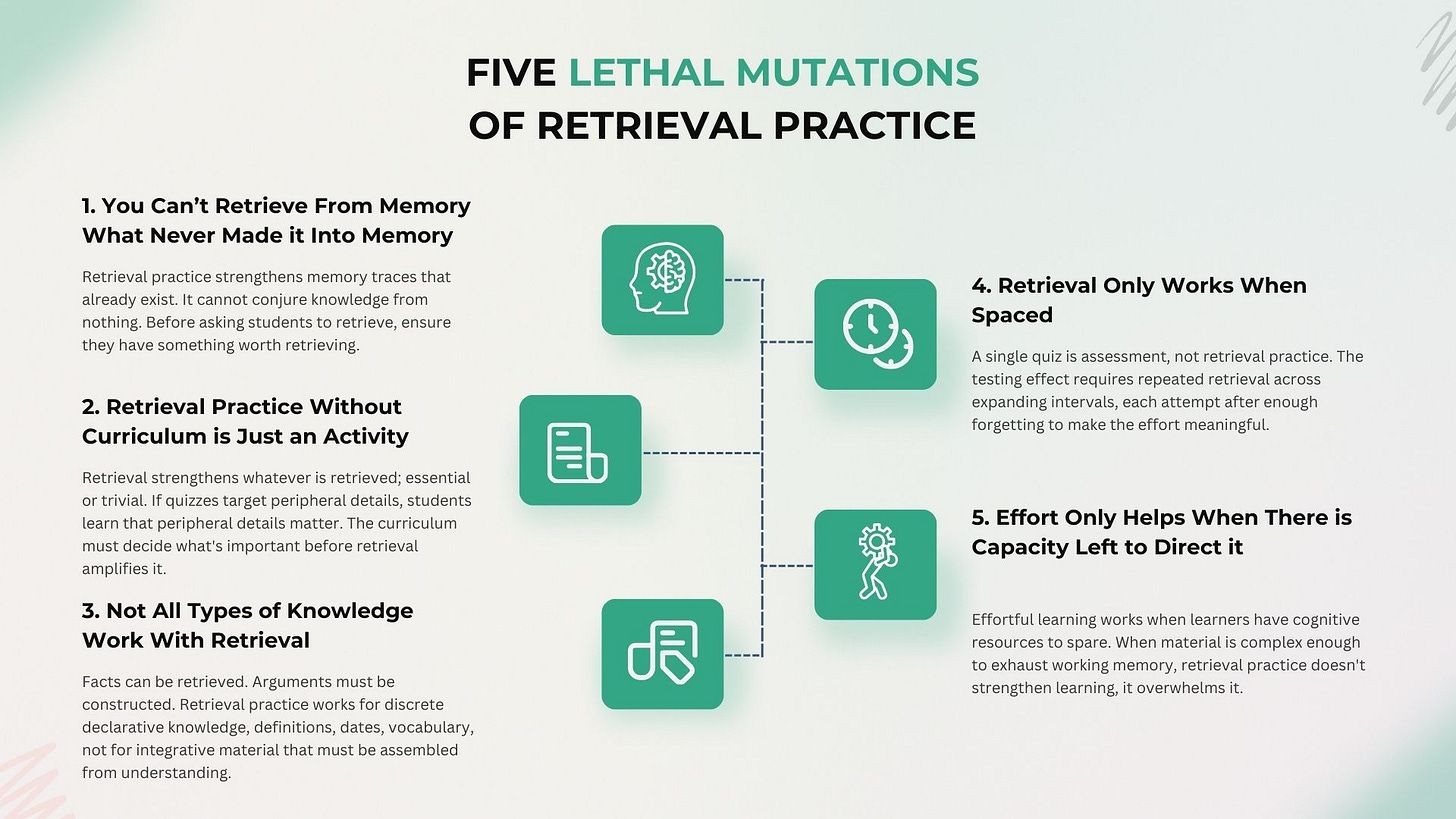
What was a promising practice became, for sometimes very understandable reasons, an ineffective or counterproductive practice. As Carl says,
retrieval practice has boundary conditions, and I feel that in the science of learning community, we have been slow to acknowledge them and what has emerged is a set of practices that are not an effective use of student time. When cognitive load is already high, when material is complex and integrative, when learners are still constructing the schema they will eventually consolidate, retrieval practice may not help. The effort it demands may exceed the cognitive resources available, converting a desirable difficulty into an undesirable one. The strategy doesn’t fail because it’s ineffective. It fails because it’s being applied outside the conditions that make it effective.
Today, though, I’m not talking about practice. Today I want to talk about policy, and one policy in particular: teacher licensing requirements.
Two Paths Diverge In A Policy Context
As with many things in education, we have to begin with No Child Left Behind, since the legacy of this law still impacts how our education system operates today. One thing NCLB required was that some teachers be “highly qualified.” Specifically this applied to teachers of “English, reading or language arts, mathematics, science, foreign languages, civics and government, economics, arts, history, and geography—and to teachers who provide instruction in these subjects to students with limited English proficiency (LEP) and students with disabilities.” As with many reforms before it, the authors of NCLB operated under the assumption that teachers were not adequately prepared or qualified to teach (as was the case with the Regan Era reforms that NCLB updated). So, to solve this problem, states were required to assure that all teachers were highly qualified. This didn’t just apply to new teachers, either. Current teachers had 4 years from the passage of the law to become highly qualified or face losing their license. There were basically three components to being highly qualified.
Teachers needed a bachelor’s degree related to the content area they will be teaching.
Teachers need to satisfy the training and certification requirements set out by each state.
Teachers need to prove they have adequate content knowledge for their subject and/or grade level (e.g. elementary teachers don’t all need to prove they know calculus even though they are teaching math).
While certification requirements varied by state, the result of the law was that most states’ requirements ended up looking pretty much the same. Some states would accept national tests like the Praxis series to determine subject matter knowledge, some states use their own exams. The amount of student teaching or the required credit hours or how many observations of teaching were required may also be different from state to state. Whether this meant all states were preparing quality educators continues to be up for debate but what I want to point out here is that the law (as well as subsequent policy) was trying to raise teacher quality and assure more rigorous preparation of educators. Moreover, the policy was largely a success in terms of getting almost all teachers to meet the new highly qualified requirements.
Most teachers met their states’ requirements to be considered highly qualified under NCLB. According to state reports, 94 percent of teachers were highly qualified in 2006–07.
What’s more, the law succeeded in getting more highly qualified teachers into the neediest classrooms.
The percentage of teachers who were not highly qualified under NCLB was higher for special education teachers and middle school teachers, as well as for teachers in high-poverty and high-minority schools. Moreover, even among teachers who were considered highly qualified, teachers in high-poverty schools had less experience and were less likely to have a degree in the subject they taught than teachers in more affluent schools.
Yet, despite all of this and at at the same time, there was a nationwide push for alternatives to traditional teacher certification. Often times the same states that were models for NCLB-style education reforms were leading the charge away from traditional licensing and preparation of teachers. The Fordham institute, no friend to public schools or university-based traditional teacher prep programs, reports that alternative certification pathways in Texas expanded following a 1999 law that aimed to make it easier and faster to train teachers.
They find that the plan achieved its primary goal admirably and quickly. The total number of initial certifications—i.e., individuals receiving their first teaching certificate—rose from roughly 14,000 in 2000 to 28,000 by 2007, driven in large measure by those attaining alternative program certification. Growth flattened after that but alternative pathways continued to produce 50 percent or more of all new teacher certifications through the end of the study period in 2020.
But
Alternatively-certified ELA and math teachers produced modestly lower (but still statistically-significant) value-added scores in both subjects. Teachers certified through for-profit alternative programs scored lower on all measured outcomes compared to their non-profit alt-cert peers, but uncertified teachers were lowest of all on every measure. They were most likely to leave the profession within five years and had the worst value-added scores of any other subgroup.
Deneault and Riehl conclude that allowing alternative-certification programs—for-profit and non-profit alike—achieved Texas policymakers’ goal of filling educator vacancies, even though the new hires were of somewhat lower quality than traditionally-certified teachers.
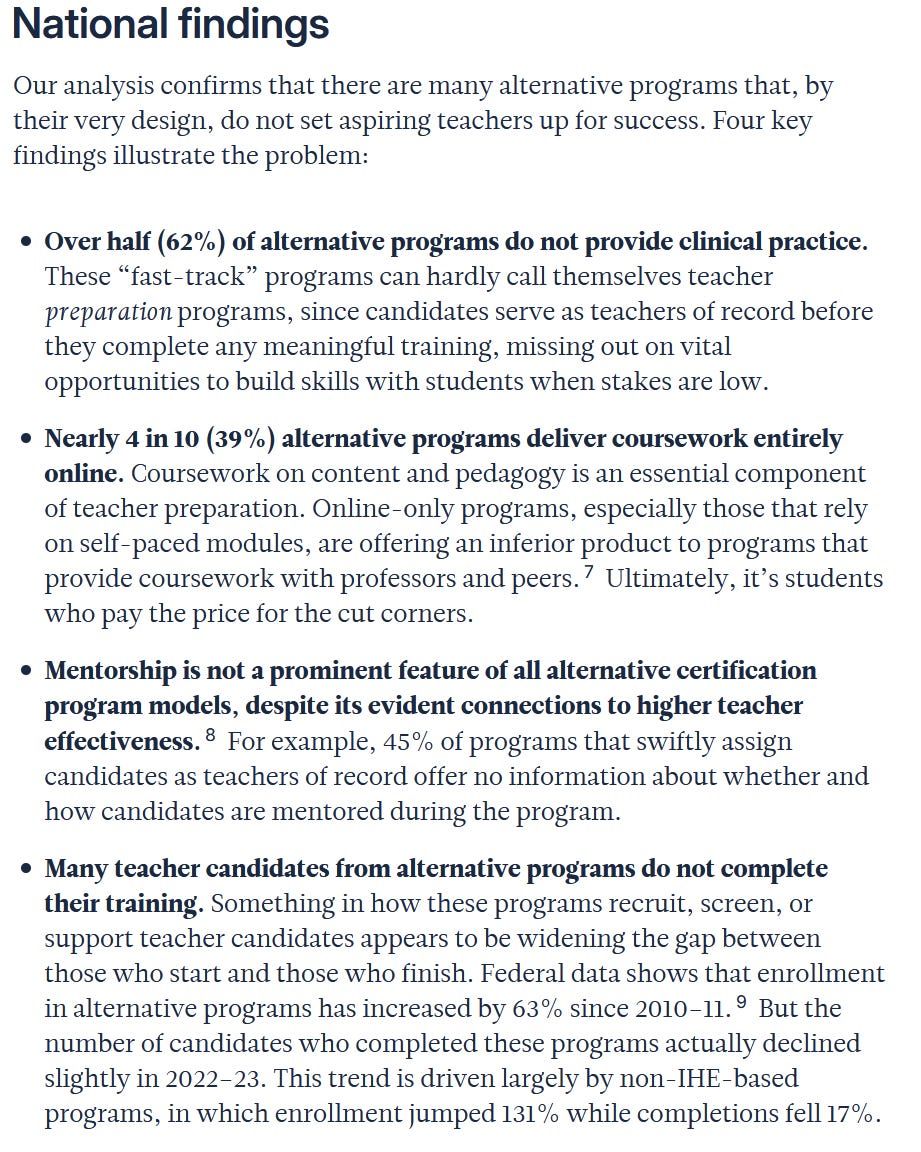
While Texas is far and away the leader in alternative pathway teachers, with more than half of new teachers lacking a certification, alternative pathways have become more popular over the last two decades. Unfortunately, these programs are, like their Texan counterparts, often of very poor quality. The NCTQ, an organization that routinely blasts traditional teacher preparation as inadequate, pulled no punches in their nationwide evaluation of alternative pathways last summer.
source
Our policymakers are, in a sense, embracing and pursuing two opposite policies simultaneously. Indeed, now that Texas has gone from the poster child for teacher quality to outright abandonment of teacher quality, all in the span of about 20 years, they are back to working on teacher quality again. Now, most of the funding is going to teacher incentive pay, not to their training and preparation, but there is some budget cutout for that, as well as for professional development for teachers already in the workforce. It remains to be seen, however, what will happen with the school budget in Texas now that the voucher program is rolling out. If other states are a guide, it will get very expensive for them.
It’s Scholastic Alchemy
I said up top that one reason I like think in terms of scholastic alchemy is that it helps see through the reforms to the purposes of policies. While so much of the ed reform movement was wrapped up in No Child Left Behind’s push for teacher quality, states were struggling to fill teaching vacancies in rural and poor schools, in special education classrooms, English language learning classrooms, and in mathematics at all levels. Training a highly qualified teacher takes time! They need to go to college. They need to do student teaching and take courses on learning and pass exams to verify they understand the content they’re expected to teach. Lawmakers need immediate solutions, especially solutions they can point to in the next election cycle. So, an easy “win” is to expand faster alternative pathways into teaching. Concomitantly, making traditional teacher training pathways more rigorous provides prospective teachers with an incentive to pursue the alternative pathways. What we’ve done, by simultaneously demanding more of university-based teacher preparation and then implementing alternative pathways, is push people from the former to the latter. Even more interesting is that some alternative certifications require you to eventually obtain a regular teaching certificate after some set amount of time. So, if you were trying to avoid the commitment of full certification, then those requirements are probably just going to make you leave the teaching profession entirely, as was found in the NCTQ report. It’s not clear to me that policymakers understand that these two systems interact. Traditional pathways and alternative pathways do not exist in vacuums wholly separate from one another but somehow we keep penning policy as if they are. So, yeah, there you go. Scholastic Alchemy. We get cold grey lead instead of chemical gold.